Oven Repair
Wolf Oven Still Locked Hours Later in Weston — Latch, Fuse or Sensor?
Most Wolf doors still locked after self-clean are not faulty: the control is waiting on a cavity temperature rather than a clock, and that wait runs well past the end of heating. Here is what to watch, and the point where waiting stops being the answer.
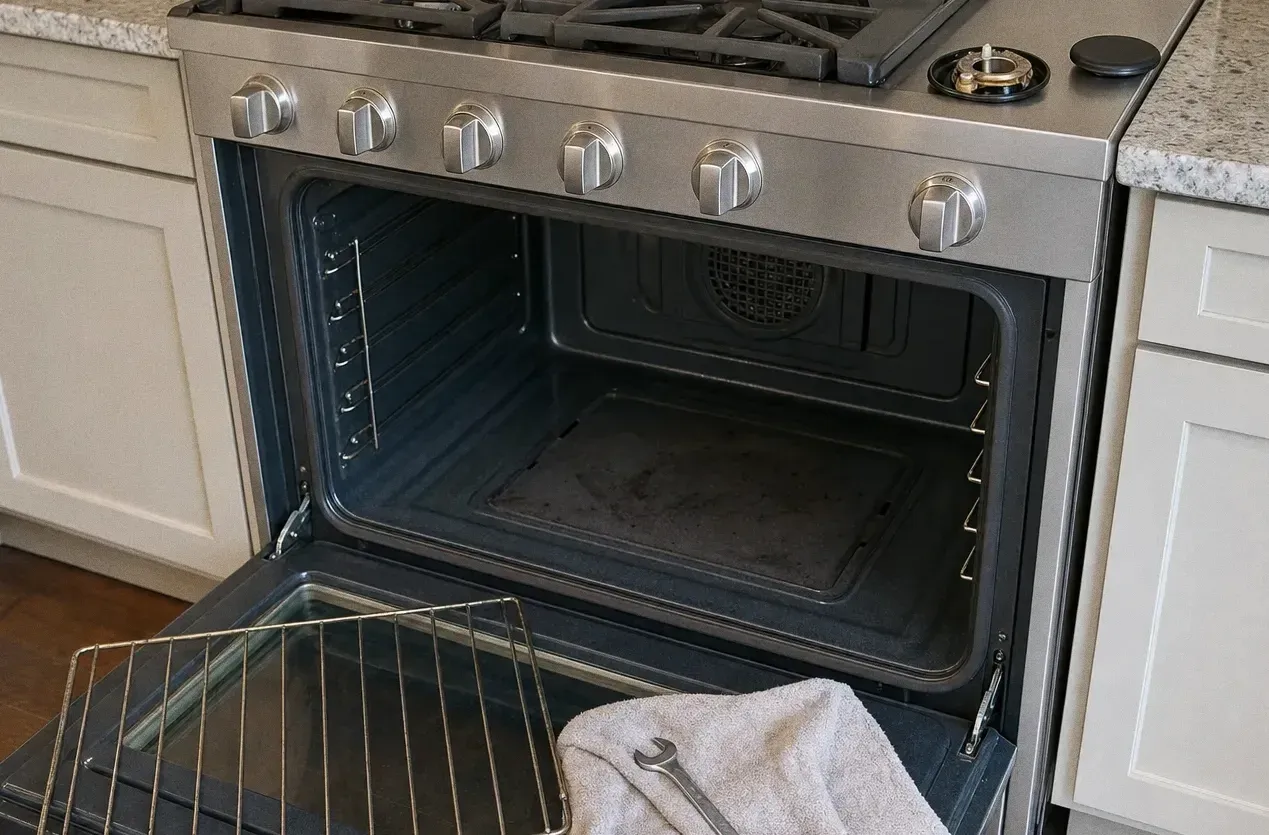
The honest headline is that most of these resolve themselves. Somebody runs the cleaning cycle, the timer expires, the door stays shut, and the household concludes within twenty minutes that the appliance has failed. In the great majority of cases it has not failed — it is still working, and the work it is doing is cooling down.
That is worth internalising before anything else, because almost every expensive outcome in this category begins with an intervention that was not necessary. Breakers get cycled, screwdrivers appear, doors get leaned on. The correct first move is to establish what normal looks like and then to watch it.
First: how long is it supposed to stay locked?
Release is governed by temperature, not elapsed time. The control keeps the door secured until the cavity has fallen below the level it is waiting to see, and that level is reached a long while after the heating phase has ended. The cycle timer finishing and the door releasing are two separate events, sometimes separated by a good deal of the evening.
Seen from the kitchen, a normal cool-down is quiet and slow. The panel might show a cleaning indicator, a cooling message, or just the clock. A fan very often keeps running well past the point where anything else seems to be happening, and its continued running is reassurance rather than cause for concern.
While the appliance works through it, record four things: whether the panel is lit and responsive, whether you can hear the fan, whether any code has come up, and whether the door glass still gives off heat. Those observations cost nothing at the time and are impossible to reconstruct once someone has cut the power.
The wait stops being the answer when the appliance has clearly finished. Cool glass, no fan, a normal idle display — and still latched. That combination means the release either was never commanded or was never confirmed. In the Hastings end of town, where kitchens near the old station tend to be compact and the appliance is only a few feet from where people sit, it is easy to hear exactly when the fan stops; in the wide, low kitchens up on Silver Hill it is not, so check rather than assume.
Locked, or locked and dead? They are different faults
The display sorts this into two categories immediately. If the panel is illuminated and responds to touch, the appliance is alive and withholding the door. If the panel is completely dark, the door is not being withheld at all — the oven has no power and the latch is stranded in whatever position it held.
Where the panel is dark, examine the breaker once. One deliberate interruption of the supply counts as a test: a display that comes back tells you supply was the problem and lets the sequence continue. Understand it as information gathering rather than as a remedy, because the distinction determines what you do next.
If the supply is present and the panel remains dark, the thermal fuse is the leading suspect. That fuse does not trip and recover the way a breaker does. Once it opens it stays open, and fitting a new one is the only route back. It is deliberately the weakest link, sacrificing itself so that costlier parts survive, and after the hottest cycle the appliance ever runs it is a common casualty.
Which is precisely why cycling the breaker over and over achieves nothing. It cannot close a fuse that has opened, it will not free a bolt that is mechanically bound, and where a real electrical fault exists it just reproduces the conditions that created it.
The mechanism behind the door
Underneath the terminology there is a motor, a bolt, a switch and a controller. The motor drives the bolt across to secure the door and back to free it. The switch reports which of those two positions the bolt has actually reached. The controller declines to release the door until the report matches the command.
That arrangement produces two failures that look identical from the front and are entirely different underneath. Either the bolt never travelled — nothing moved, and the door is genuinely fastened — or the bolt travelled correctly and the switch failed to say so, leaving the door mechanically free while the controller behaves as though it is not. Which of the two you have decides what needs replacing.
Heat introduces a third. Self-clean takes the cavity far beyond anything ordinary baking asks, and afterwards the path the bolt travels can be fouled with hardened residue or slightly distorted, so the bolt starts moving and stops. This version usually gives itself away with a brief mechanical noise on each attempt and no result.
And this is where the reader stops. Everything above is inside a high-current appliance that may still hold serious heat, behind panels not meant to be removed in a kitchen. Watching and listening is useful; taking things apart is not. Our Oven Repair page sets out what an appointment covers — the $95 service call starts it, thermostat or sensor calibration work falls between $140 and $710, and door hinge, glass or seal repairs between $200 and $980.
Codes that return after a power cycle
Codes describe symptoms. They name what the board noticed — a reading outside its expected window, a confirmation that failed to arrive — rather than identifying the component responsible, and more than one physical fault can produce the same display.
The behaviour of the code carries more information than the code itself. One that disappears after the power is interrupted and never returns points at something transient, which is entirely plausible after an unusually hot cycle. One that reappears within seconds of the appliance restarting is describing a condition that has not gone away, and that is a much stronger signal.
So write it down first. Better still, photograph the panel. Interrupting the power very often clears the display, and the number of households that reset an appliance and then cannot tell anyone what it had been showing is remarkable. Thirty seconds of recording saves a diagnostic step later.
When to stop and call
Three signs mean the waiting strategy is finished. A burning electrical smell coming from the appliance. A breaker that trips a second time after being reset. Or a door still fastened long after everything has cooled and gone silent. None of those are improved by more patience.
A visit replaces inference with measurement: continuity through the thermal fuse, whether the latch motor is commanded and whether it responds, what the position switch reports, and what the controller currently believes about the door. Those four answers close the question, and none of them can be obtained from the kitchen side of the appliance.
One instruction to take seriously — do not force the door. It was not designed to be overridden by hand, and levering at it commonly damages the latch assembly and the door itself, adding two problems to the one you started with. A door that will not open is not a strength contest.
Wolf Repair Weston covers Silver Hill, Hastings and Weston Center. Reach us through the booking link on this page or on (617) 340-2816, and have the model number plus any code from the panel to hand when you do.
Still asked on the phone
Should I run self-clean before a holiday?
It is the worst week to choose. The cycle pushes the cavity far above normal cooking temperatures, and parts already near the end of their life tend to fail then rather than during ordinary baking. Running it when the kitchen is needed within a day or two turns a modest repair into a crisis. Pick a quiet week instead, and in the meantime wipe spills while the cavity is still warm — that alone reduces how often the cycle is needed.
How long should the door stay locked after a self-clean cycle?
Longer than most people expect, and no fixed figure applies. The control is watching a temperature rather than counting down, so the release happens when the cavity has cooled sufficiently, not when the timer finishes. Your model's use and care guide is the place to look for the expected behaviour. As a practical rule, an appliance with a fan still turning and glass still warm has not reached the release point yet.
Will cutting power at the breaker release the latch?
Isolating the appliance removes the only thing capable of driving the bolt back, so the mechanism stays exactly where it stood. One interruption is still worth performing as a diagnostic, since a controller that wakes up and completes its routine has told you the original problem was in the electronics rather than the mechanism. Doing it repeatedly changes nothing, and it cannot help at all where the bolt is physically bound.