Range Hood Repair
Weston Kitchens: Why a Wolf Hood Moves Air and Misses the Smoke
A hood that roars but misses the smoke is usually starved of replacement air or strangled by its duct, not short of blower power. Test the pull with a sheet of tissue, wash the baffles, then look at elbows, diameter reductions and the cap outside.
You sear something on a Tuesday evening, the hood is on its highest setting and roaring, and the smoke still rolls off the pan, past the front of the canopy and out into the room. By the time the pan comes off the heat the far end of the kitchen is hazy and an alarm somewhere in the hallway is thinking about it.
The instinctive reading is that the blower is weak. Usually the blower is fine. What has changed, or was never right, is one of the two things on either side of it: the air the house is able to feed into the kitchen, and the duct the hood is trying to push that air out through. Neither gets inspected, because neither is visible.
First, measure the pull instead of listening to it
Noise is not airflow, and a pro-style hood makes plenty of noise doing very little. With the hood running, hold one sheet of tissue flat up against the underside of the filters. If it holds itself there, the hood is pulling. If it slides off or hangs limp, it is not. That converts “it feels weak” into something you can act on.
Run the test at every speed rather than only the top one, because a hood that holds tissue on two and drops it on four is telling you about the speed control, not about the duct.
Now repeat the whole thing twice: first with the kitchen closed up as it normally is, then again with a window cracked a few inches. If the tissue only holds with the window open, stop reading the duct section — your problem is the air that cannot get back into the house. If it fails both ways, the fault is downstream of the hood, and the filters come first.
Weston geometry decides a lot of this before anyone touches anything. The Silver Hill houses off Concord Road are wide and low-ceilinged with flat roofs, so their hoods run long horizontal routes rather than short vertical ones. Around Weston Center the kitchen is often in a rear ell with very little headroom above the canopy, which forces turns into the run almost immediately.
Baffles and grease: the boring answer, checked first
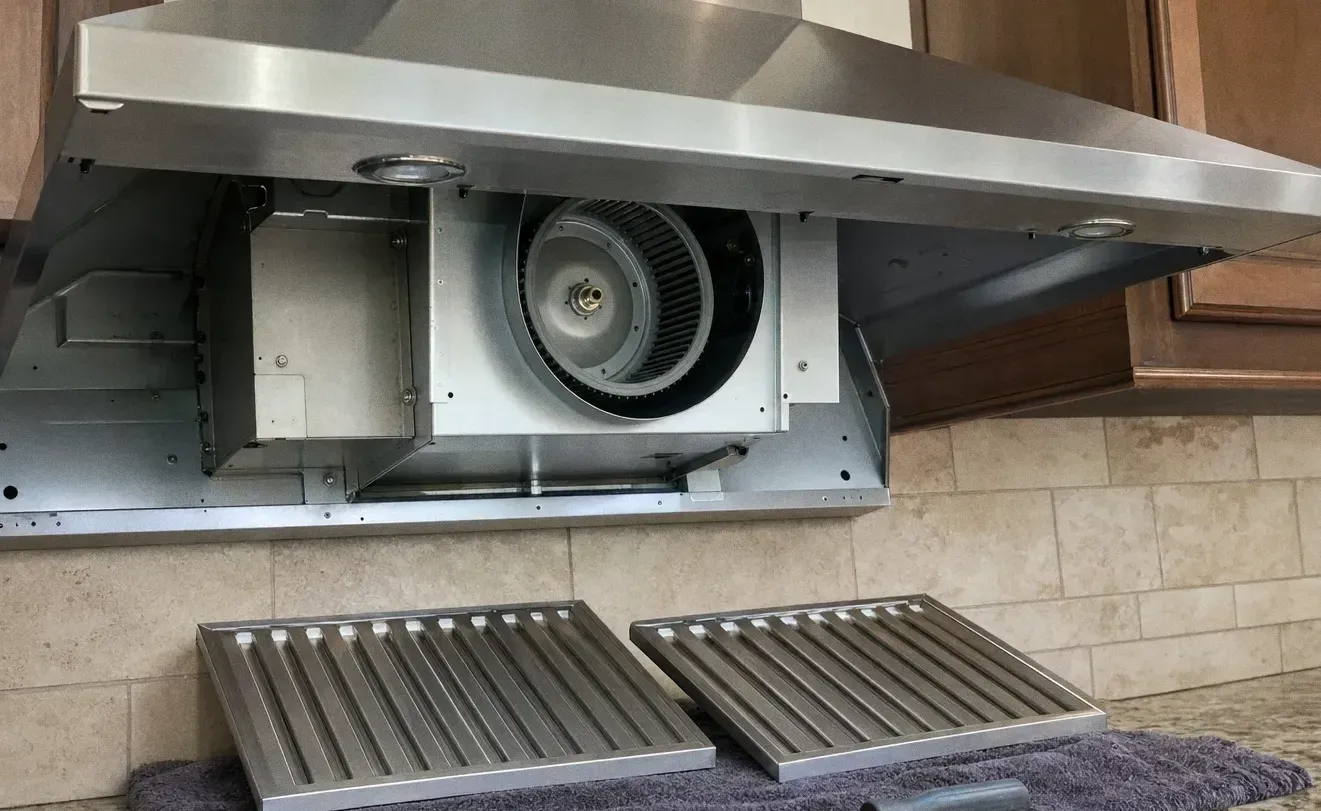
Baffle filters are the steel chevrons set into the underside of the canopy, and unlike the aluminium mesh in lighter hoods they are made to be washed rather than thrown out. Check your own use and care guide, but on most of these the baffles go back in indefinitely provided they are cleaned.
A loaded baffle behaves differently from a clogged mesh. It does not choke the airflow so much as stop separating grease out of it, and the grease then travels somewhere considerably less convenient. Slide the baffles out of their track, degrease them properly in hot water, dry them and refit them the right way round.
Then look at the part nobody cleans, which is the blower wheel itself. Grease that got past the filters collects on the blades and puts the wheel out of balance, and that changes the sound before it changes the airflow. A hood that has grown noisier over two seasons without getting any less effective is describing its own wheel.
The way to tell “needs cleaning” from “is not the problem” is simply to repeat the tissue test after the filters go back. No change means the filters were never the fault, and you have eliminated the cheapest possibility for the price of an hour.
Why closing the kitchen door makes it worse
A blower can only remove as much air as the house is able to let back in. That sounds obvious written down and it is the single most missed cause of this complaint. In February, in a house with newer windows, foam in the roof and a properly sealed envelope, a large hood on full can pull the kitchen slightly negative and simply stall against itself.
The symptoms are distinctive once you know them. Performance changes when a door or window is opened. The blower note climbs but the smoke does not move. There may be a whistle at the edge of a closed door. And if there is an open fireplace anywhere nearby, it may smoke back into the room while the hood is running, which is the clearest warning sign on the list.
A bigger blower does not fix this and often makes it worse, because a stronger fan pulls harder against the same shortage of replacement air. Dedicated make-up air is the answer, and supplying it is a code matter rather than a repair. Above a certain exhaust rate, current mechanical code generally calls for make-up air to be provided; the rate at which that kicks in and the method of delivering it are both for a licensed installer working to the edition in force here.
Weston makes this worse than average. The Kendal Green additions that opened the kitchen into a family room feel enormous, but volume is not the same as supply, and a well-sealed house does not care how big the room is.
The duct is the part nobody inspects
Every ninety-degree elbow in a run costs far more resistance than its physical length suggests, which is why installers work in equivalent length rather than measured length. A hood specified for a short straight exit through a nearby wall will disappoint badly at the end of a long horizontal route with four turns in it, even though the manufacturer’s number on the box has not changed.
Diameter is the other one. Narrow the run at any single point and the whole run is capped there — which is what happens wherever a new hood was joined to ducting already sitting in the ceiling. Check what the installation manual specifies as the minimum size for your hood and see whether the run actually delivers it end to end. Flexible duct used where rigid was specified is the same problem in a different form — the ribbed wall is turbulent, and the concertina that forms at every bend is worse still.
Finish at the outside. A wall or roof cap can be blocked by a screen packed with lint and grease, by a damper that has gummed itself part-open or stuck shut, or by birds and nesting material. On the flat roofs out towards Silver Hill and on the ell roofs around Weston Center, that cap sits somewhere nobody has looked at since the day it went on.
Inspect what can be seen safely: the cap from the ground, the first stretch above the hood with the filters out and a torch. Ladders onto roofs and opened duct inside a ceiling are where this stops.
Where a technician actually helps
Plenty of this you can finish yourself. Washing the baffles, clearing the visible first section of duct, proving the make-up air effect with an open window, and clearing a wall cap you can reach standing on the ground are all reasonable homeowner jobs, and they resolve a good share of these calls.
Leave the rest. A blower that hums without turning involves a capacitor and a live circuit. Lamps that cut out as the hood warms up, and a speed control that only sometimes responds, are electrical faults. Any smell of hot insulation means switch it off at the breaker.
What a visit adds is measurement: static pressure across the run, current draw at the motor, and damper behaviour observed while the blower is actually running. Those three separate a tired motor from a strangled duct, which is the distinction that decides whether anything needs replacing at all. Our service call is $95. We work across Weston and out to Kendal Green, Silver Hill and Hastings. Our number and our booking link are both at the head of this page.
Still asked on the phone
Can I use flexible duct instead of rigid?
Check what your installation manual specifies, and expect it to ask for rigid. Flexible duct has a ribbed inner wall that generates turbulence along its entire length, and it concertinas at every bend, costing far more airflow than the same distance of smooth pipe. Where flex has been used on a long route, that is often the whole answer.
Should I fit a more powerful blower?
Usually not, and it can make matters worse. If the kitchen cannot draw replacement air in, a stronger fan pulls harder against the same shortage and may start affecting other appliances in the house. Deal with the restriction first: filters, duct, cap, make-up air. Extra power only helps once the air has somewhere to go.
Can grease build-up in a duct be a fire risk?
Grease accumulating in a run is a maintenance matter, and it is exactly why the baffles and the ductwork are meant to be cleaned. Treat it as routine housekeeping rather than an emergency: wash the filters on a regular rhythm, and have the accessible first section and the blower wheel cleaned when someone is in for other work.